.avif)

.svg)
Baby's sensory development on a wool play mat: what the science says (0–12 months)
.png)
Wool baby play mat: the scientific milestones of your baby's development.
Between birth and 12 months, a baby can only see strong contrasts clearly, their sense of touch has already been active since the womb, and their motor skills progress with every minute spent on the floor. A play mat that combines high-contrast patterns with wool texture zones is built around these three precise developmental windows, not around a vague marketing claim.
0 to 2 months: eyesight that only picks up contrast
At birth, a baby's visual acuity is between 20/200 and 20/400, compared with 20/20 in an adult, according to All About Vision. In practical terms, something an adult sees sharply at 6 metres has to be brought within a metre of a newborn for them to make it out as clearly.
Newborns see most sharply at 20 to 25 centimetres from their face, roughly the distance to a parent's face during breastfeeding or bottle-feeding, according to the American Optometric Association (AOA). Beyond that, the image stays blurry for several weeks.
At this stage, the still-immature visual cortex cannot tell shades of colour apart very well. That is why newborns spontaneously fix their gaze on high-contrast black-and-white patterns rather than on pastel colours, which remain indistinguishable to them. A zone of high-contrast patterns placed within the baby's field of vision, especially during tummy time, taps directly into this natural preference.
Colour vision then develops gradually, and the AOA considers it to become genuinely good at around 5 months. Moving from a black-and-white pattern zone to the coloured zones of the mat therefore keeps pace with a measurable change in development, not just an aesthetic variation.
Gazing at a high-contrast pattern is not just a passive reflex: each fixation trains the eye to follow an outline, laying the groundwork for the eye control needed a little later to track a moving object or to coordinate eye and hand.
Touch, active from the 8th week of pregnancy
Touch is the first sense to develop in humans. It appears as early as the 8th week of pregnancy, well before sight or hearing, and the foetus already responds to contact on the mother's abdomen, according to a review published in MDPI Behavioral Sciences.
Three types of nerve fibre carry tactile information: Aβ fibres for precisely locating a touch, Aδ fibres for pain and temperature, and C-tactile fibres, which specialise in slow, gentle stimulation close to skin temperature, around 32 °C, at a speed of about 3 centimetres per second. That is exactly the profile of a caress.
This tactile stimulation is not just a sensation: it contributes to the maturation of the somatosensory cortex and the insula, the brain regions that process sensory, emotional and cognitive information.
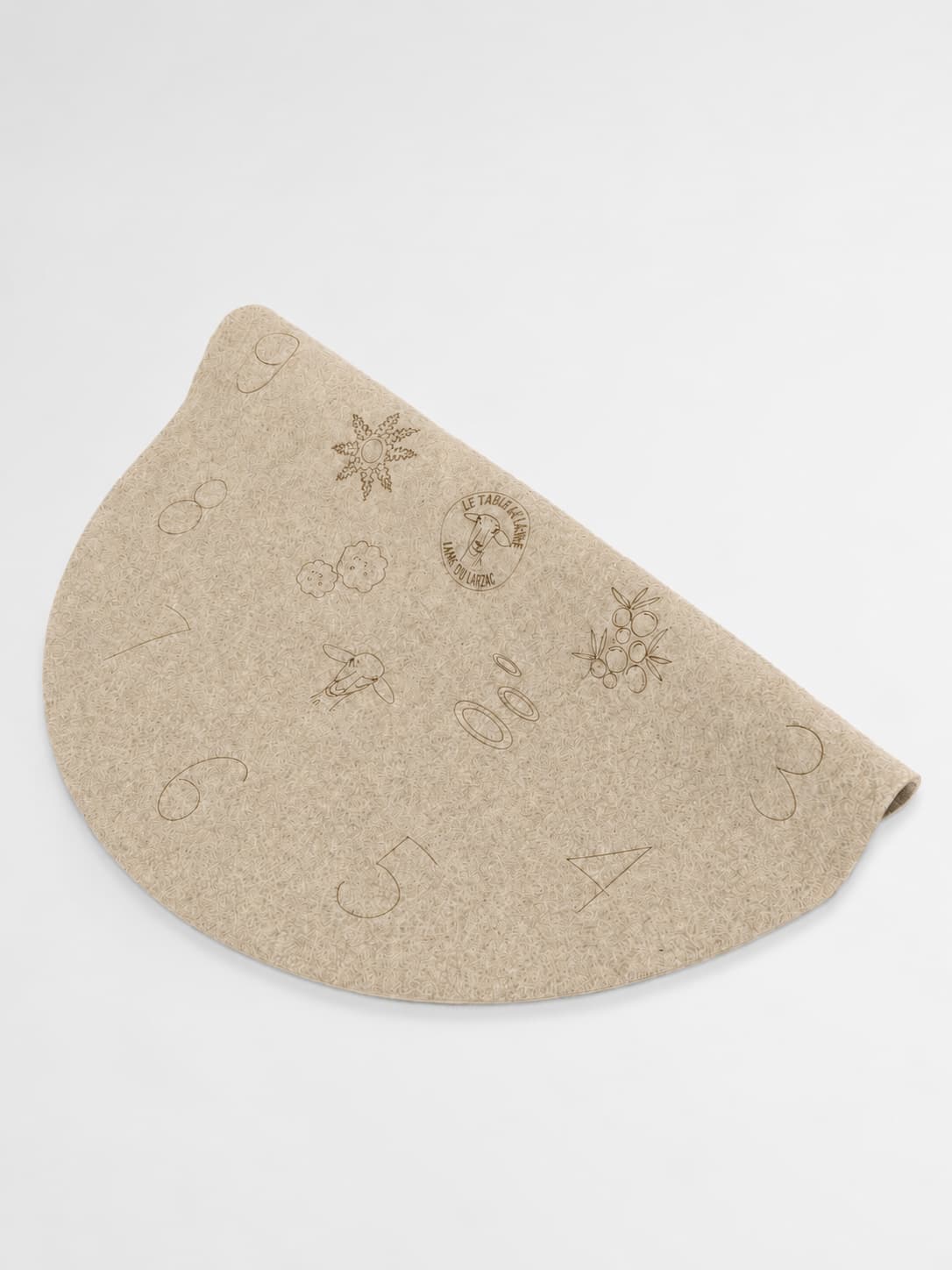
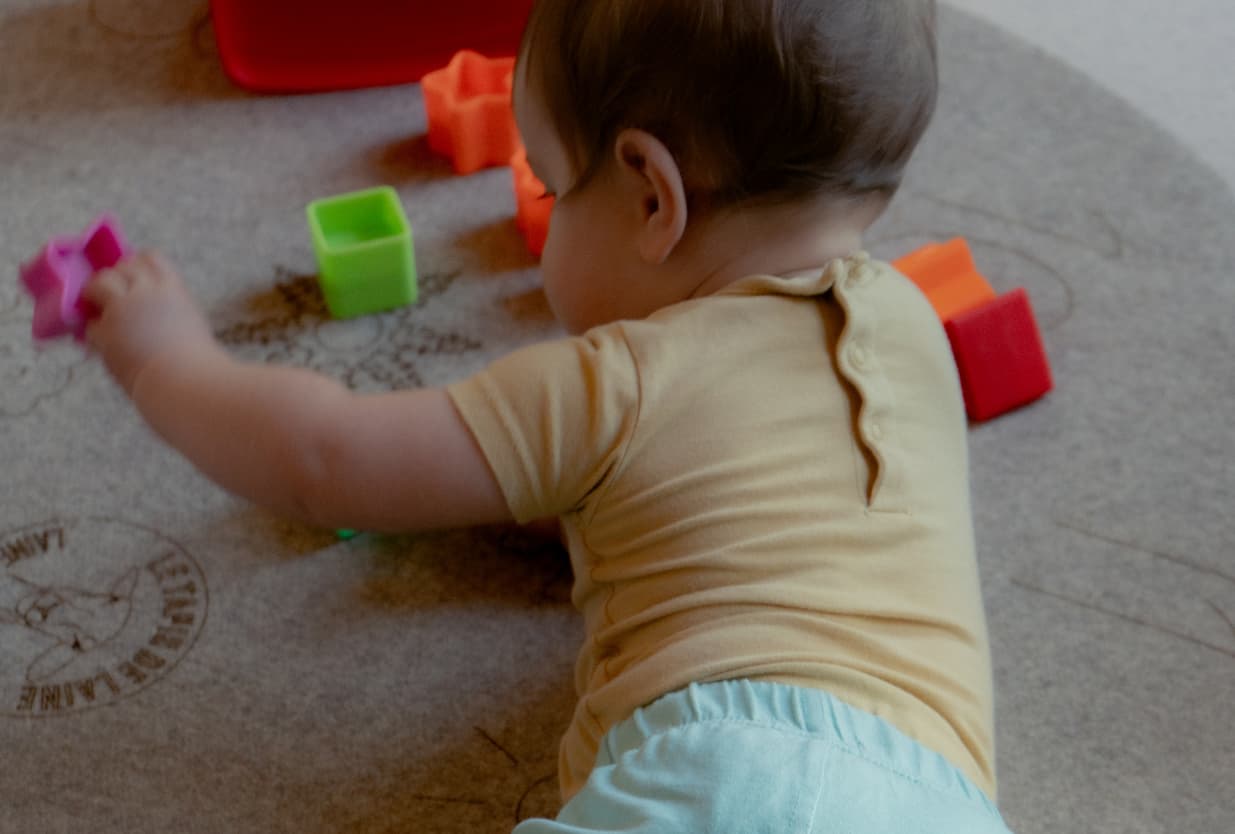
A mat whose zones offer different wool densities and raised textures gives the baby far more tactile information during floor time than a single flat, uniform surface. The wool fibre itself, naturally crimped, already has a texture that smooth synthetic fibres lack.
A baby who always encounters the same texture eventually gets used to it and pays less attention to it, a phenomenon known as sensory habituation that is well documented in developmental psychology. Alternating texture zones, on the other hand, keeps their attention engaged and creates more opportunities to stimulate the discriminative touch fibres, rather than the emotional fibres alone.
Motor skills are built minute by minute, on the floor
Tummy time, the time a baby spends lying on their front, is the main recommendation for infant motor development. The NICHD (the US National Institute of Child Health and Human Development) recommends two to three sessions of 3 to 5 minutes a day from birth.
This time increases gradually: at least 15 to 30 minutes a day at around 2 months, then at least 60 minutes a day at around 6 months, according to guidelines published by Pathways.org, an organisation specialising in child development. The recommendation is then to keep going until the baby starts to crawl.
The milestones follow one another at a recognisable pace: brief head lifts at around 2 weeks, holding the head up at around 2 months, propping up on the forearms at around 3 months, lifting the chest off the floor at around 4 months, pushing up on straight arms and reaching for objects at around 5 months, then rolling over in both directions at around 6 months.
Tummy time also reduces the risk of plagiocephaly (flat head syndrome) and positional torticollis. With at least an hour a day in total from 6 months, the thickness and comfort of the surface under the baby are no longer a minor detail: an 8 mm wool mat cushions these repeated sessions without flattening out.
The advice to continue floor time until crawling, usually between 8 and 10 months, means the mat stays in use long after the newborn period: sitting, bearing weight on the hands and then the first attempts at getting around are all practised on the same surface, with different cushioning needs at each stage.
Frequently asked questions
How much time a day should my baby spend on their play mat? It depends on their age: 3 to 5 minutes per session in the newborn period, 15 to 30 minutes in total per day at around 2 months, then at least 60 minutes a day at around 6 months, according to guidelines from the NICHD and Pathways.org.
At what age can a baby really see colours? Colour perception develops gradually and becomes genuinely good at around 5 months, according to the American Optometric Association. Before that age, strong contrasts remain the most effective visual stimulus.
Is touch of any use before a baby can grasp objects? Yes: touch is active from the 8th week of pregnancy, long before voluntary grasping, which only appears at around 5 to 6 months. The texture zones stimulate this sense from the very first weeks, without waiting until the baby can handle anything.
What to keep in mind day to day
The simplest rule of thumb to apply at home: favour the high-contrast pattern zone during the first two months, then let your baby freely explore the texture zones as soon as they spend time on their tummy, without waiting for a specific age to introduce one or the other.
.svg)


How we make things
.avif)
5 mat Pilates exercises to get started at home
Pilates mats: why choose a wool mat?
Yoga nidra: why this practice is booming in 2026

Back-to-school season: how to set up a comfortable play corner for your baby
Yoga mats: the 2026 trends to know about
%20(1)%20(1).jpg)
Yoga for back-to-school stress: what the science really recommends
What thickness should you choose for your yoga mat?
Baby's sensory development on a wool play mat: what the science says (0–12 months)
Wool or synthetic play mat: what the numbers show
Natural yoga mats: wool, cork, jute or rubber — which should you choose?
.jpg)
Why wool is the best-performing material for a yoga mat
Which yoga mat should you choose for your practice: yoga, pilates or meditation?

.svg)
.svg)
.svg)
.svg)
.svg)
.svg)