.avif)

.svg)
Lacaune wool throw: meeting Lucille, weaver in Argelès-sur-Mer
.jpg)
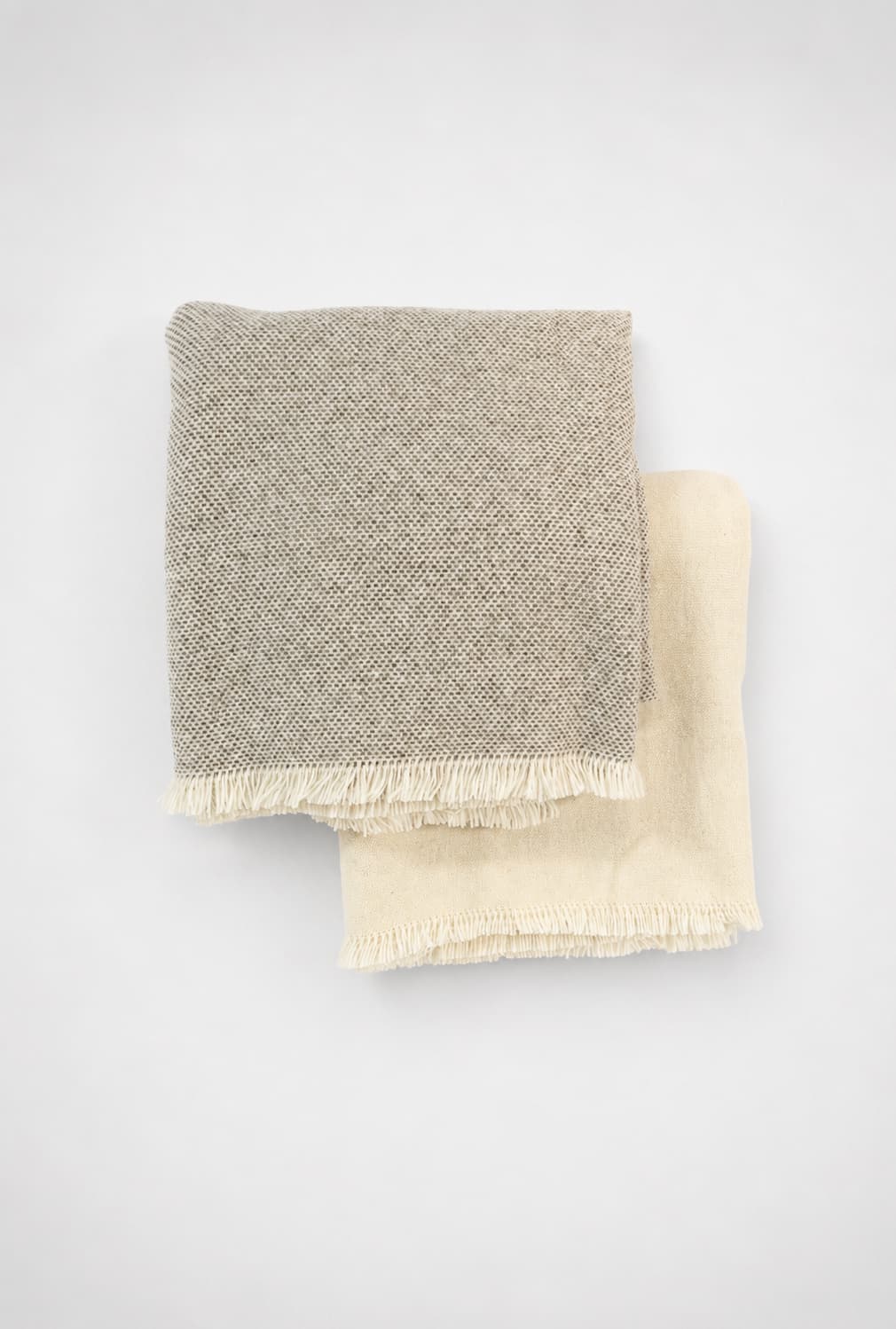
Our Lacaune wool throw is woven in Argelès-sur-Mer, in Lucille's workshop. It measures 150 × 135 cm, is made of 100% Lacaune wool and only comes in small batches. I went to meet her to understand what happens between the fleece of a Larzac ewe and the blanket lying on your sofa.
Lucille hasn't always been a weaver. She learned the craft late, through a career change, from a master weaver who passed everything on to her.
Meeting Lucille in Argelès-sur-Mer
Lucille's workshop is in Argelès-sur-Mer, in the Pyrénées-Orientales, between the sea and the first foothills of the Albères. It's a large shed with corrugated-metal walls, home to dark green mechanical looms. Cones of undyed yarn wait on the shelves.
The first thing that strikes you is the noise. The steady clack of the beater against the cloth, the weft thread shooting from one selvedge to the other between hundreds of taut warp threads. A throw grows to the rhythm of that motion, row after row.
I wanted to know who weaves our throws, and how. I came away with a story of transmission, the kind you rarely read about anymore.
A career change, and a master weaver to learn everything from
Lucille came to weaving through a career change.
A master weaver taught her the trade, step by step: setting up a warp, adjusting the thread tension, reading a fabric by hand to feel whether it's right. It's the old way of learning, from the one who knows to the one who wants to know.
In France's craft trades (métiers d'art), this master-to-apprentice transmission is still very common. France officially recognises 281 craft activities, i.e. 198 trades and 83 specialities, listed in the decree of 24 December 2015.
Today, Lucille runs mechanical looms. She sets them up, watches over them and finishes every piece by hand as it comes off the machine.
Why Lacaune wool
The Lacaune is a dairy sheep from the south of the Massif Central, raised first and foremost for its milk. The Roquefort PDO specifications require the milk to come "from dairy flocks made up of ewes of the Lacaune breed".
The breed has been selected for cheese for fifty years. "The genetics we create are calibrated for the Roquefort system," explains Ioan Romieu of Upra Lacaune. The wool is a by-product of the annual shearing.
Yet this wool has few outlets. France has 5.4 million sheep and produces about 10,100 tonnes of wool a year, but only 4% of those fleeces are put to use. According to people in the industry, nearly 90% of French wool ends up being thrown away.
In Aveyron alone, 700 tonnes of wool leave the farms every year. Choosing Lacaune wool for a throw means giving this material value instead of letting it go to waste. In 2025, Le Tapis de laine paid €15,000 to sheep farmers.
The fibre also has qualities of its own. Coarser than merino, it makes a dense, springy fabric that holds its shape. Like all wool, it regulates moisture and heat, which makes it a pleasant blanket in winter as well as in spring and autumn.
From yarn to throw: how it's woven
The throw goes through five stages, from the ewe to the finished piece. Lucille handles the last three, in her Argelès-sur-Mer workshop.
- Shearing: Lacaune ewes are shorn once a year on the Larzac plateau and in the Lacaune mountains.
- Washing and spinning: the fleece is washed, carded, then spun.
- Warping: Lucille sets up the warp, the hundreds of parallel threads stretched along the full length of the loom.
- Weaving: the weft thread crosses the warp row after row until the fabric takes shape.
- Finishing: each throw is cut, checked and finished by hand.
The result is a 150 × 135 cm throw in 100% Lacaune wool, with a dense feel and a natural off-white colour. It is produced in a limited edition.
Frequently asked questions about the Lacaune wool throw
Where is Le Tapis de laine's Lacaune wool throw made?
It is woven in Argelès-sur-Mer (Pyrénées-Orientales) by Lucille, an independent weaver. The wool comes from Lacaune ewes raised in the south of the Massif Central.
What size is the throw?
The throw measures 150 × 135 cm. It covers a two-seater sofa or the foot of a double bed.
Is Lacaune wool itchy?
It is coarser than merino, so it feels more rustic directly against the skin. It softens with use.
How do I care for a wool throw?
Air it regularly rather than washing it: wool sheds most odours on its own. If it gets stained, hand-wash in cold water with a wool soap, then dry flat.
Why is the throw a limited edition?
Each batch depends on the wool available and on the weaving time of a single artisan, so quantities stay small.
.svg)


How we make things
.avif)
Lacaune wool throw: meeting Lucille, weaver in Argelès-sur-Mer
.jpg)
Autumn yoga: 6 poses to ease into the change of season
5 mat Pilates exercises to get started at home
Pilates mats: why choose a wool mat?
Yoga nidra: why this practice is booming in 2026

Back-to-school season: how to set up a comfortable play corner for your baby

Yoga mats: the 2026 trends to know about
%20(1)%20(1).jpg)
Yoga for back-to-school stress: what the science really recommends
What thickness should you choose for your yoga mat?
.png)
Baby's sensory development on a wool play mat: what the science says (0–12 months)
Wool or synthetic play mat: what the numbers show
Natural yoga mats: wool, cork, jute or rubber — which should you choose?
.jpg)
Why wool is the best-performing material for a yoga mat
Which yoga mat should you choose for your practice: yoga, pilates or meditation?

.svg)
.svg)
.svg)
.svg)
.svg)
.svg)