.avif)

.svg)
Natural yoga mats: wool, cork, jute or rubber — which should you choose?
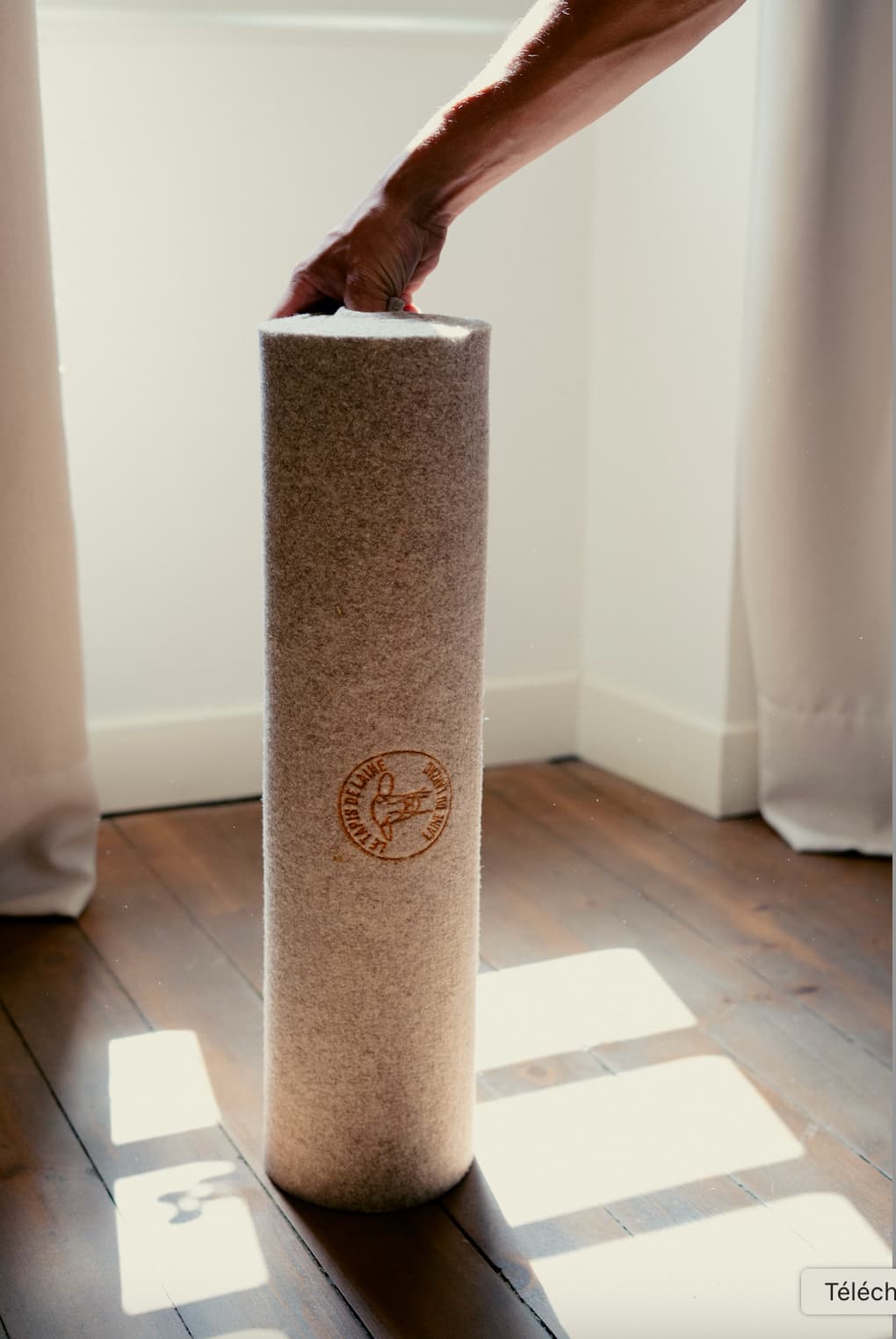
For daily practice, wool is the only material that regulates temperature in both directions — comfort held from 15 to 35 °C, and simply airing the mat after a session clears odours and bacteria. Cork has one counter-intuitive quality: its grip improves the more you sweat.
For daily practice, wool is the only material that regulates temperature in both directions — comfort held from 15 to 35 °C, and simply airing the mat after a session clears odours and bacteria. Cork has one counter-intuitive quality: its grip improves the more you sweat. Jute is light but thin, so there is little cushioning on a hard floor. Natural rubber grips better than anything, at the cost of more weight and an origin that is often far away.
All of them make a viable natural yoga mat, but they are not interchangeable. Each has concrete strengths and limits. Wool aside, none of them is local. The right choice depends on what you actually do on your mat.
Why leave PVC (and every synthetic) behind?
Most mats sold in France are still PVC or TPE, in a market of more than 3 million practitioners (Fédération Française de Yoga, 2024). These are materials that take centuries to break down and recycle poorly (ADEME, 2023). Laying plastic between yourself and the floor in the middle of a yoga session is a contradiction many practitioners end up facing.
Health sits alongside ecology: PVC contains phthalates and bisphenol A, classified as endocrine disruptors by ANSES (2023). Direct skin contact, often prolonged, often while sweating.
The 4 natural materials for yoga mats
Wool: temperature regulation and a long life
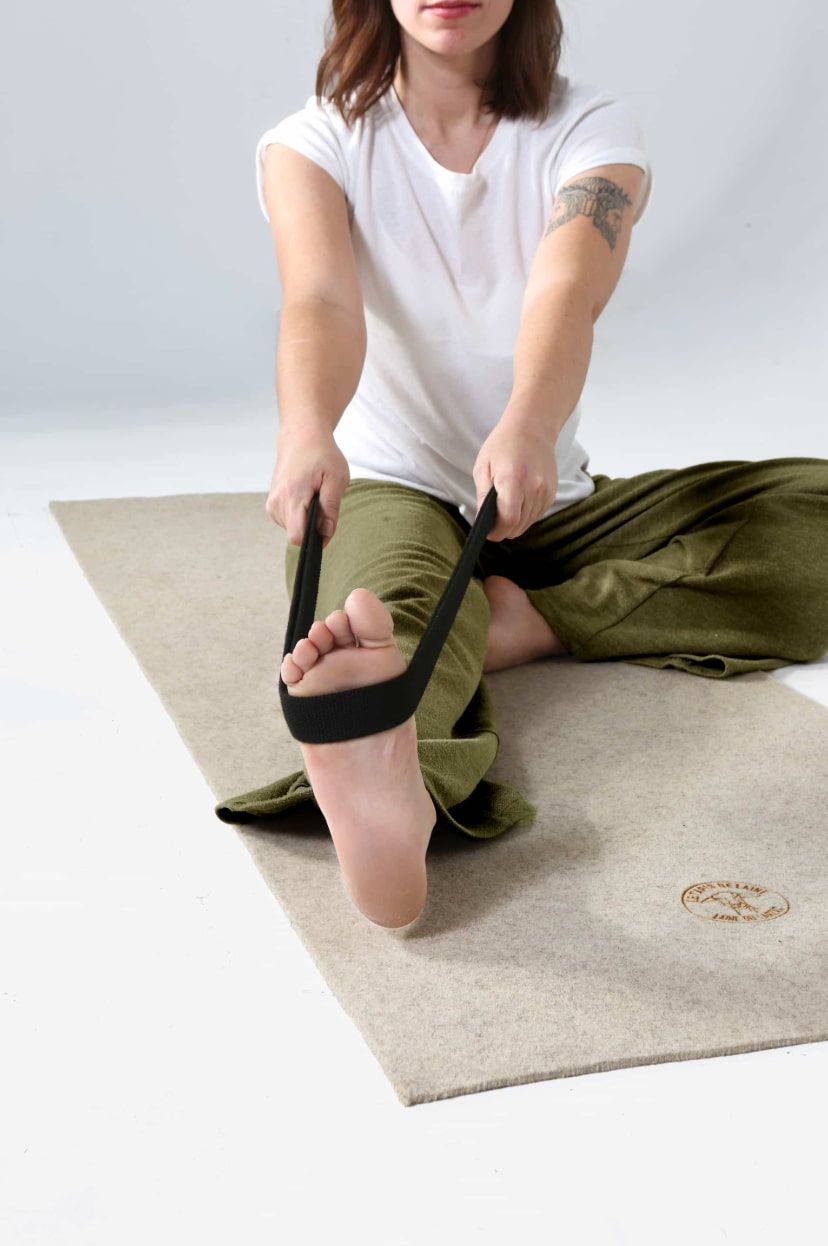
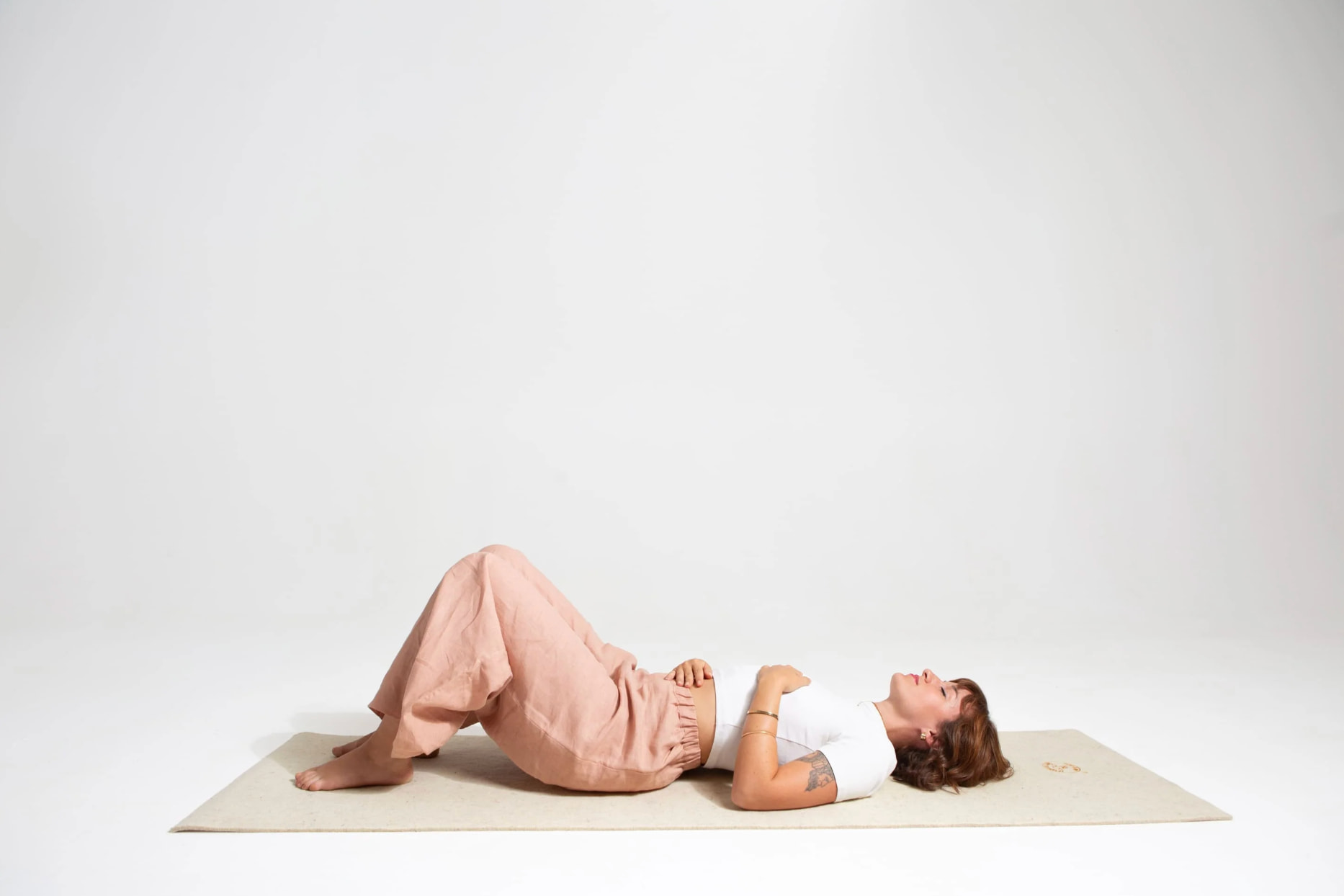
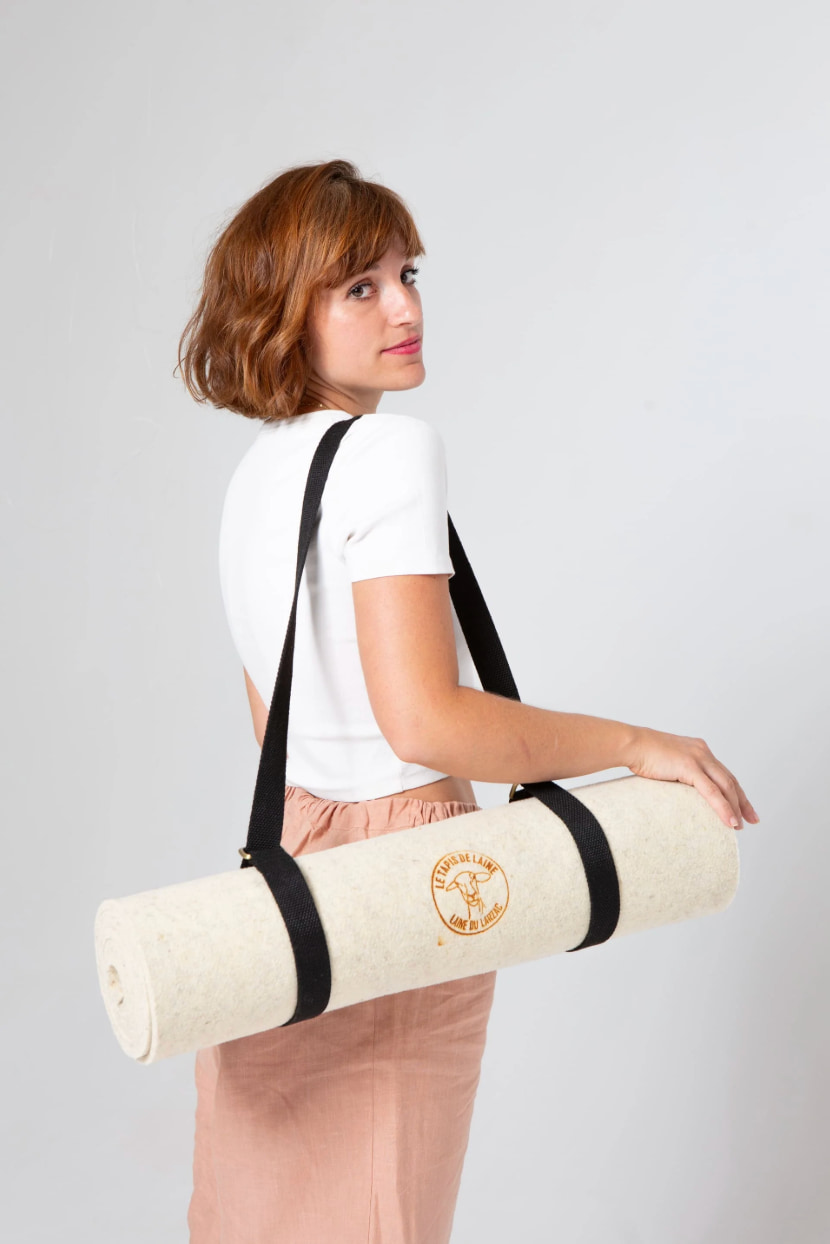
Wool is the only natural fibre that actively regulates temperature. Its scaled structure traps air, holding a comfortable feel between 15 °C and 35 °C (IWTO). That matters especially for yin yoga, meditation or yoga nidra, where the body cools quickly when held still.
It contains lanolin, a natural antiseptic that slows bacterial and fungal growth. No smell after a session, no systematic cleaning. Airing it out is enough.
Larzac wool is a by-product of milk production for Roquefort: shearing is necessary for the ewes' welfare, so the fibre exists either way. No resource is mobilised specifically for it — hence a very low carbon cost at the raw-material stage, with no dye or added chemical treatment.
The fibre also stores carbon. Roughly 50% carbon by composition, it sequesters 1.8 kg of CO₂ per kilo of material (IWTO, 2022) — carbon the ewe captured while grazing, locked into the fibre for the whole life of the mat.
On our wool mats, a non-slip treatment applied as micro-droplets on both faces provides grip without blocking the fibre's breathability.
The other side of the coin: this is a fine material that needs careful upkeep. No washing machine. Not for regular outdoor practice on dirty ground.
“Thermoregulating and comfortable, wool adapts to the wearer's environment rather than being subjected to it. That is what sets it apart from synthetic fibres over time.”
— Yann Costiou, technical director, Institut Français du Textile et de l'Habillement
Cork: grip that increases with sweat
Cork is harvested from the bark of the cork oak without felling the tree. The same tree can be harvested every 9 years for more than a century (Institut Européen du Liège, 2022).
It is also a geographically concentrated resource: cork oak forests cover around 2.7 million hectares worldwide, 80% of it across 7 Mediterranean countries, including 34% in Portugal (Institut Européen du Liège, 2022). Demand for eco-friendly products — yoga mats, corks, insulation — is putting new pressure on the sector. A tree that is over-harvested or cut too young dies without regenerating. This is a real supply issue, not a marketing argument.
Its distinctive property: the more you sweat, the better it grips. The surface takes on a little moisture, which raises the coefficient of friction. The opposite of PVC, which slips as soon as you perspire.
Antimicrobial, easy to clean, it absorbs very little water. Its weakness is mechanical: the surface erodes under intensive daily practice. Expect 3 to 5 years of useful life.
Most cork mats have a natural rubber base for stability, which makes them heavier than jute.
Jute: light, affordable, fragile
Jute grows in 4 to 6 months, without irrigation or pesticides. A mat weighs 1 to 1.5 kg, two to three times less than a rubber mat.
It is the cheapest option. But the thickness rarely exceeds 4 mm, which leaves little cushioning on a hard floor. Knees and wrists notice quickly in intense practice.
Lifespan is around 1 to 3 years. Suited to gentle or occasional practice, not to daily training.
Natural rubber: maximum grip, maximum weight
Natural rubber (hevea brasiliensis) offers the best grip of any natural material. It is the reference for technical practices with rapid transitions and heavy sweating.
In return: 3 to 4 kg on average. Not a problem if the mat stays at the studio. A chore to carry every day. The rubber smell fades after a few weeks of airing.
“In hot yoga, grip is a safety question, not a comfort one. A mat that slips exposes you to real injury.”
— Hélène Macherel, Yoga Alliance RYT-500 certified teacher, Lyon
Not advised for anyone with a latex allergy.
Comparison table
Natural materials compared
| Criterion | Wool |
Cork |
Jute |
Rubber |
|---|
🐑 = 1 point · 5 sheep = maximum score · best score per criterion highlighted in green
Which mat for which practice?
If you do yin yoga, meditation or yoga nidra, choose wool. The body cools quickly when held still, and no other natural material regulates in both directions.
For vinyasa or intensive Ashtanga, grip comes first. Cork or natural rubber, depending on how much weight you are willing to carry.
Prenatal yoga: wool. No chemicals, temperature regulation, a material that is soft against the skin.
If you are starting out or practise now and then: begin with jute. It is enough to get going, and the choice sharpens with practice.
Regular hot yoga: cork first, lighter to carry day to day, with a grip that improves as you sweat. If the intensity is genuinely high and grip is critical, natural rubber takes over.
Frequently asked questions
Is a wool mat hygienic?
Yes. Lanolin is a natural antiseptic. Airing it between sessions is enough, plus a pass with the vacuum every couple of months.
Can cork replace natural rubber?
For most practices, yes — and its grip when you sweat is actually better. Its weak point is lifespan under intensive daily use.
Can you use a jute mat every day?
For gentle yoga, yes. For daily dynamic practice, no. The thinness tires the joints and the material wears quickly.
Which material lasts longest?
Wool: 10 to 15 years. Cork and natural rubber: 3 to 5 years. Jute: 1 to 3 years. Per year of use, wool often works out cheaper than the alternatives.
How much does a natural yoga mat cost?
Jute starts at €20 to €50, but its short life raises its real annual cost. Cork and natural rubber: €60 to €120. Wool mats cost more upfront, but over 10 to 15 years of use their annual cost is often lower.
Is wool suitable for allergy sufferers?
Generally well tolerated. Lanolin can nonetheless cause reactions in people sensitive to it. A patch test before prolonged use is a sensible precaution. Natural rubber should be avoided in case of latex allergy.
What we think
There is no best material in the absolute — there is the one that fits what you do on your mat.
For varied practice without fuss over upkeep, wool goes the distance. For very dynamic yoga with technical demands, cork or rubber. And if you are still hesitating, Larzac wool mats can be returned within 30 days.
Sources: Fédération Française de Yoga, Baromètre 2024; ANSES, Évaluation des risques liés aux phtalates, 2023; IWTO, Technical Guide to Wool Properties; Institut Européen du Liège, Rapport 2022; ADEME, Guide des matières premières renouvelables, 2023.
Last updated: June 2026
.svg)


How we make things
.avif)

Rentrée : comment installer un coin d'éveil confortable pour bébé
Tapis de yoga : les tendances 2026 à connaître
%20(1)%20(1).jpg)
Yoga anti-stress de rentrée : ce que la science recommande vraiment
Quelle épaisseur choisir pour son tapis de yoga ?
.png)
L'éveil sensoriel du bébé sur un tapis en laine : ce que dit la science (0-12 mois)
Wool or synthetic play mat: what the numbers show
Natural yoga mats: wool, cork, jute or rubber — which should you choose?
.jpg)
Why wool is the best-performing material for a yoga mat
Which yoga mat should you choose for your practice: yoga, pilates or meditation?

.svg)
.svg)
.svg)
.svg)
.svg)
.svg)